
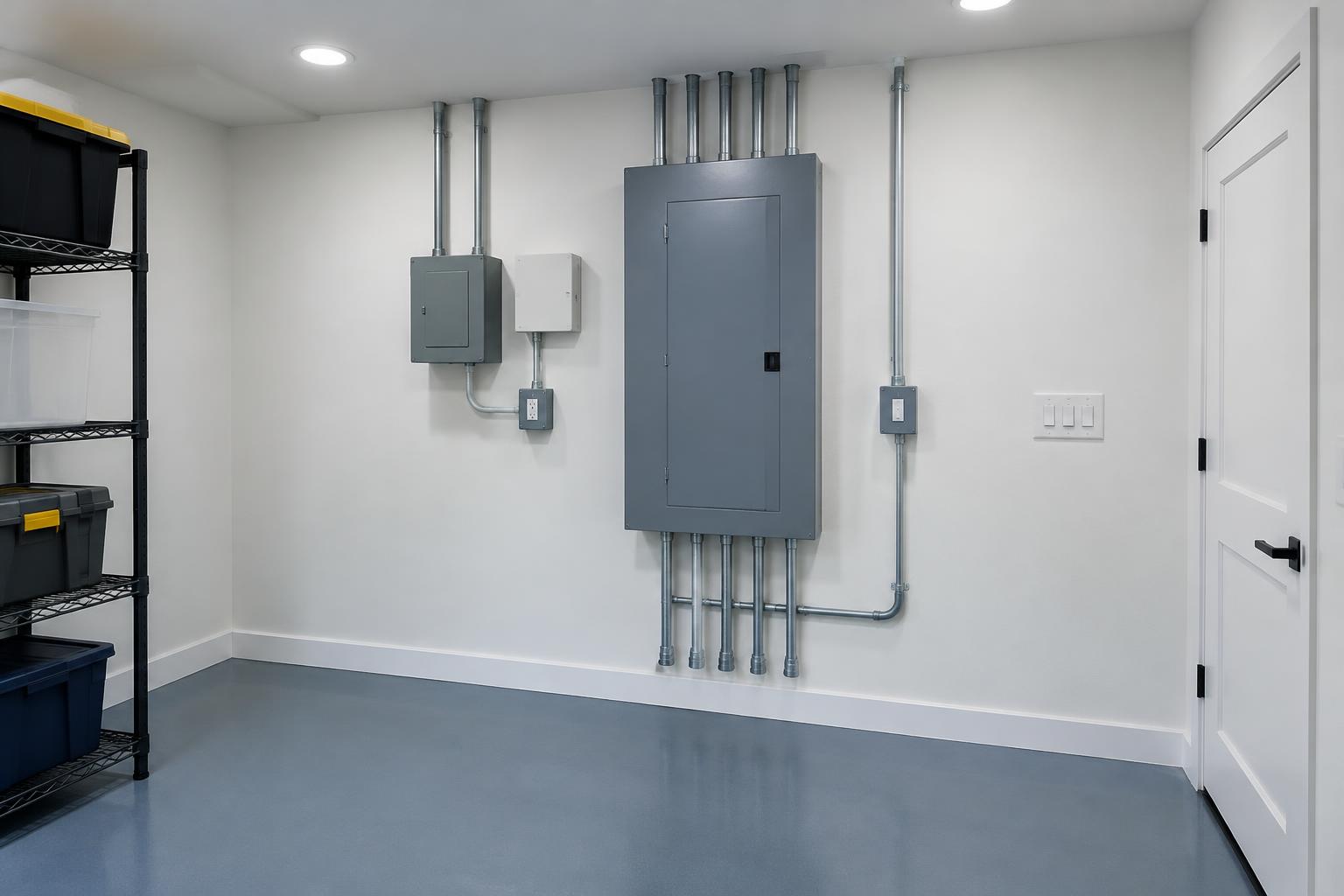
A breaker trips on purpose — it cuts power before a circuit overheats. Repeated trips point to one of three things: an overloaded circuit, a short circuit, or a ground fault. The pattern tells you which. Reset a breaker once. If it trips again, stop and have a qualified electrician look at it.
What is the breaker actually telling you?
A circuit breaker is a safety device with one job: interrupt the current before the wire behind the wall gets hot enough to cause a fire. When it trips, it worked. The problem is whatever made it trip.
There are three common causes. An overload means more current is being drawn than the circuit is rated to carry. A short circuit means a hot conductor is touching a neutral or another hot conductor, which produces a very large current very fast. A ground fault means current is finding a path to ground it was never meant to take — through a metal box, through water, or through a person.
The pattern is the diagnosis. A breaker that trips when you run the space heater and the microwave at the same time behaves differently from one that trips the instant you plug something in, and both behave differently from one that trips with nothing obvious running at all.
Overloads: the most common cause in pre-war Chicago housing
A lot of Chicago's housing stock was wired for a world with far fewer appliances. A bungalow or two-flat bedroom circuit that once ran a lamp and a radio now runs a window air conditioner in August and a 1,500-watt space heater in January, plus a television, a router and three phone chargers.
Overload trips have a signature. They happen minutes after you add a load, not instantly. They repeat with the same combination of devices. They are often seasonal — heating season is when we hear about them most, because portable heaters pull more current than almost anything else a homeowner plugs in.
If that describes your situation, move the heavy load to a different circuit on a different breaker and see whether the trips stop. That is useful information, not a fix. The real answer is usually more circuits, which means work at the panel and a conversation about what the service can actually support.
Shorts and ground faults: not a wait-and-see problem
A short circuit trips a breaker immediately and hard. It can come with a pop, a flash, a smell of hot plastic, or a scorch mark on a receptacle. A ground fault may be quieter but is the one most likely to shock someone, which is why kitchens, bathrooms, basements, garages and outdoor receptacles are the places protection is required.
If you see any of these, stop using the circuit and get an electrician involved: a burning or fishy plastic smell near an outlet or panel, scorching or melted plastic, a buzzing or crackling sound from a switch or receptacle, an outlet or cover plate that is warm to the touch, or a breaker that trips again within seconds of being reset.
None of those are things to live with for a few weeks. The Electrical Safety Foundation International publishes plain-language homeowner guidance on these warning signs at https://www.esfi.org/ and it is worth reading before you decide something can wait.
GFCI and AFCI devices trip for different reasons
Not everything that trips is a standard breaker. A GFCI — the outlet with the TEST and RESET buttons, or a breaker version of the same thing — watches for current leaking to ground and cuts power in a fraction of a second. It is doing its job when it trips on a wet outdoor receptacle or a failing appliance, and it will trip at loads far below the circuit rating.
An AFCI is designed to detect the signature of an arc — the kind produced by a damaged cord, a loose terminal screw or a nail driven through a cable. AFCI trips are the ones homeowners most often call nuisance trips, and sometimes they are. Sometimes they are the device finding damage inside a wall that nothing else would have found.
A useful homeowner check: if a group of outlets is dead but no breaker in the panel looks tripped, look for a GFCI with a popped RESET button in a bathroom, kitchen, garage or basement. One GFCI often protects several downstream outlets.
What is safe to do — and three things to stop doing
Safe: unplug everything on the affected circuit, reset the breaker once by pushing it fully OFF and then ON, and reintroduce devices one at a time to see what brings it down. Safe: note which rooms and outlets went dead, because that maps the circuit. Safe: replace or stop using an appliance or cord that is clearly damaged.
Three things not to do. Do not open the panel cover — the main lugs stay energized even with every breaker off, and there is no photograph worth taking in there. Do not handle, strip, cap or tape wiring. And do not replace a tripping breaker with a larger one; the breaker is sized to protect the wire, and a bigger breaker simply removes the protection while leaving the same undersized wire in the wall.
That is also our rule when customers send us photos. Describe what happened, show us the outlet or the panel door from outside if it helps, but do not open a panel or touch wiring to get a picture.
Is it the appliance, the wiring, or the panel?
If the trips follow one device from outlet to outlet, the device is the problem. If the trips stay with one circuit no matter what you plug into it, the problem is in the wiring, a device on that circuit, or a connection somewhere along it.
Some patterns point further upstream. Lights that dim noticeably every time a motor starts, multiple circuits tripping, a breaker that feels loose or will not stay set, or a panel with no room left for another circuit all suggest the question is bigger than one outlet. Older homes sometimes still have fuses, cloth-sheathed wiring, or a service that was sized for a much smaller electrical load than the house now carries.
That is the point where an assessment is worth more than another reset. Our electrical work starts with reviewing the condition and the scope — what circuits exist, what the panel can take, and what the work would actually involve — before anyone quotes anything. We coordinate appropriately qualified trade professionals for the work itself, and permits and credentials are confirmed for the specific scope before that work begins.
When a remodel is what triggers the electrical question
Breaker problems often surface during a project rather than before one. A bathroom gets a heated floor, a new vanity light and a fan; a kitchen gets a second appliance circuit; a basement gets finished and suddenly needs lighting, receptacles and smoke and carbon monoxide detection. All of that lands on a panel that was sized decades ago.
Planning the electrical scope early is cheaper than discovering mid-project that there are no spare circuits. When we price a bathroom project or a larger remodel, the written estimate identifies allowances, exclusions and who is responsible for permits, so nobody is surprised halfway through.
Permitting and licensing requirements for electrical work are set by the municipality, and they differ between Chicago and the suburbs we serve. Start with the City of Chicago Department of Buildings at https://www.chicago.gov/city/en/depts/bldgs.html, or your own village's building department, and confirm the requirements for your specific scope. We also wrote a general overview of contractor licensing in Chicago if you want the broader picture first.
What to tell us when you call
The more specific you are, the faster the assessment goes. Useful details: which rooms or outlets lost power, what was running at the moment it tripped, how often it happens and whether it is new, whether anything smells or sounds wrong, and whether the property is a single-family home, a two-flat, a condo or a commercial space.
Also helpful: whether the building is owner-occupied or tenanted, whether there has been recent work in the walls, and whether you have fuses or breakers. If you already know the panel is full, say so.
We work with residential and commercial properties by appointment, Monday through Saturday. Call (312) 585-6226 or use the contact page and tell us what the circuit is doing. If there is a burning smell, scorching, or a breaker that will not hold, treat it as urgent and stop using the circuit until someone has looked at it.
Frequently asked questions
How many times can I safely reset a tripping breaker?
Once. If it holds and does not trip again, the cause was probably a one-time overload. If it trips a second time — and especially if it trips within seconds — stop resetting it. Repeated resets put current back into whatever condition caused the trip.
Why does my breaker trip only in winter?
Almost always portable heaters. A single 1,500-watt heater draws about 12.5 amps, which is most of a standard 15-amp circuit by itself. Add a television, a lamp and a charger on the same circuit and you are at the limit. Moving the heater to another circuit usually confirms it.
My GFCI outlet keeps tripping but the breaker in the panel is fine. What does that mean?
The GFCI is detecting current leaking to ground, which is a different fault than an overload. Common causes are moisture at an outdoor or bathroom receptacle, a failing appliance, or a damaged cord. If it trips with nothing plugged in, the device or the wiring needs attention.
Can I just have a bigger breaker installed so it stops tripping?
No. The breaker size is matched to the wire size behind the wall. Putting a larger breaker on the same wire lets the wire carry more current than it was rated for without anything cutting the power. The correct fix is usually redistributing the load or adding a circuit.
Do I need a permit to add a circuit in Chicago?
Requirements depend on the scope and the municipality, and we confirm them for each project before work starts rather than assuming. Check the City of Chicago Department of Buildings, or your own village building department if you are in the suburbs, and confirm for your specific scope.